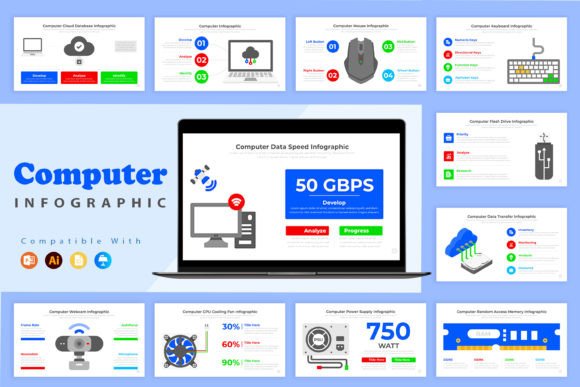
Computer Infographic Design Templates for Keynote
Imagine you have a complex idea about how a new software architecture works, or you need to explain a technical process to a non-technical team. Words alone can feel abstract, but a well-designed visual can make the concept click instantly. This is the core value of a Computer Infographic Design Keynote template. It’s not just a slideshow background; it’s a structured visual framework specifically crafted for presenting computer-related information—from hardware specifications to data flow charts and software development cycles.
At its simplest, it is a pre-designed set of slides for Apple’s Keynote presentation software. The template comes with a coordinated color palette, dedicated layout spaces for icons and data visualizations like charts and graphs, and a library of relevant symbols—think of server icons, network diagrams, or code snippets. The professional, clean design removes the burden of starting from a blank canvas, allowing you to focus on your content rather than wrestling with design alignment and consistency.
Why It Matters Across Different Roles
The utility of such a specialized tool varies significantly depending on who is using it and what they aim to achieve. A tech educator and a startup founder might both download the same file, but their priorities and evaluation criteria will be worlds apart.
For Educators and Trainers
When teaching computer science concepts or IT fundamentals, clarity and learning value are paramount. A Computer Infographic Design Keynote template allows an educator to transform a dry lecture on, say, cybersecurity threats, into an engaging visual story. The pre-made charts can quickly illustrate statistics, while the icon set can visually differentiate between malware types. The priority here is not just ease of use, but the template’s ability to serve as a pedagogical aid. It saves precious time otherwise spent on drawing diagrams, ensuring that the educational content remains the focus. For a teacher evaluating such a template, the inclusion of simple, intuitive layouts and the availability in formats like Google Slides (for classroom compatibility) might be the decisive factors.
For Professionals and Technical Presenters
Software developers, system architects, and IT managers often need to present complex information to stakeholders, clients, or internal teams. For them, the professional design and credibility conveyed by the template are critical. A sleek, modern layout implicitly signals competence and attention to detail. Their evaluation heavily weights quality and flexibility—can the template’s charts be easily adapted to show real-time performance data? Can the vector graphics in the Adobe Illustrator file version be modified to represent their specific network topology? The long-term usefulness comes from reusing and adapting the template for various projects, from client pitches to quarterly infrastructure reviews. Speed is also key; an “instant download” feature means they can assemble a compelling presentation for a last-minute meeting without delay.
Creators, Entrepreneurs, and Marketers
This group looks at the template through a lens of communication and commercial value. A tech blogger might use it to create more visually appealing content for their audience, breaking down a new gadget’s features. A startup founder pitching a tech product needs to explain its workings quickly and persuasively to potential investors who may not have a deep technical background. Here, the template’s role in “transforming intricate information into an engaging visual narrative” is its primary benefit. Their priority is presentation impact. They might prioritize the ease of editing in Canva or PowerPoint due to familiarity, and value the “100% editable” promise to ensure the final output aligns perfectly with their brand colors and messaging. For them, the template is a tool to bridge the gap between complex functionality and market understanding.
The Beginner’s Perspective
A student, a hobbyist, or someone new to presentation design approaches this tool with different concerns. Ease of use and a user-friendly design are the most important factors. The fear of a complicated, time-consuming design process can be a real barrier. A good Computer Infographic Design Keynote template for a beginner acts as a guided tutorial. The intuitive icons and pre-assembled layouts show them how information should be structured visually. The provided documentation and links to free fonts are supportive features that reduce anxiety. Their goal is often to complete a single project—a class presentation on internet history or a club talk on PC building—with clarity and style, without needing to become a graphic designer overnight. They are less likely to need the Adobe Illustrator EPS file but will greatly appreciate the simplicity of the drag-and-drop editors.
Meanwhile, a freelance designer or a publisher who regularly produces technical content might evaluate the template’s creativity and reliability. Can it serve as a dependable, high-quality starting point for multiple clients, ensuring a consistent output while still allowing for creative customization? The availability of the source file in Illustrator format could be a major advantage for deep customization, making the template a flexible asset in their professional toolkit.
Identifying If It Matches Your Needs
To decide if this specific template is right for you, start by defining your project’s core requirement. Is it about speed—getting a professional-looking deck ready in an hour? Then the instant download and easy-to-edit claims are your checkpoints. Is it about depth and customization for repeated use? Then scrutinize the included file formats, especially the vector-based EPS, which allows for limitless scaling and modification without loss of quality.
Consider your skill level honestly. If you are comfortable only with PowerPoint or Google Slides, verify that those file versions are included and that editing is straightforward. If you are a Keynote power user, the native .key file will be your go-to. For a project aimed at a highly technical audience, assess whether the chart types and icon library are sufficiently detailed for your topic. For a broader audience, judge whether the visuals are clear and not overly cluttered with assumed knowledge.
Ultimately, a Computer Infographic Design Keynote template is a practical investment in clearer communication. It matters not because it is a generic presentation tool, but because it is a specialized one. It acknowledges that computer-related information has its own unique visual language, and it provides a structured, accessible way for anyone—from the novice to the expert—to speak that language effectively.